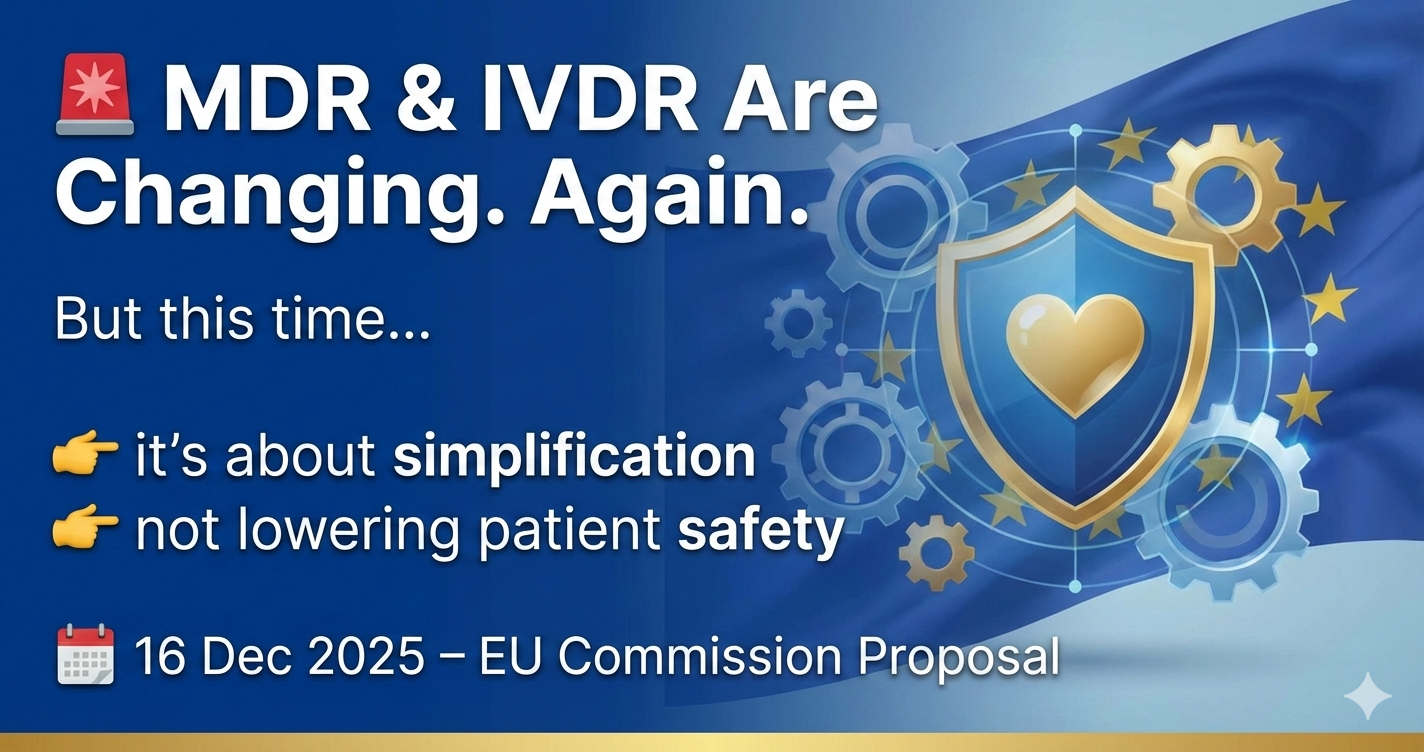
What Is Changing, Why It Matters, and How Manufacturers Should Prepare?
Executive Summary
On 16 December 2025, the European Commission released a legislative proposal to simplify and reduce the burden of the EU Medical Devices Regulation (MDR) and In Vitro Diagnostic Regulation (IVDR). This targeted revision is not a rollback of safety requirements. Instead, it is a structural correction aimed at restoring predictability, proportionality, and innovation capacity while maintaining a high level of patient protection .
The proposal responds directly to:
- persistent notified body bottlenecks
- disproportionate conformity assessment requirements
- regulatory unpredictability
- negative impacts on SMEs, innovation, and device availability
If adopted, this revision will fundamentally change how manufacturers demonstrate compliance, how notified bodies operate, and how evidence is generated and reviewed.
Why the Commission Is Revising MDR & IVDR?
The Commission’s targeted evaluation confirmed that MDR and IVDR have improved safety and oversight—but at a cost that is often excessive and misaligned with device risk .
Key systemic problems identified include:
- lengthy and unpredictable certification timelines
- fragmented interpretations across Member States
- duplicate documentation and reporting
- limited digitalisation
- insufficient pathways for breakthrough and orphan devices
These issues have already contributed to:
- market withdrawals
- delayed launches
- reduced access to niche and innovative devices
Key Regulatory Changes Introduced by the Proposal
1. Proportionality-Based Conformity Assessment
What changes
- Reduced notified body involvement for Class IIa, IIb, B, and C devices
- Portfolio-based technical documentation reviews instead of device-by-device
- No routine technical documentation review during surveillance
- Remote audits allowed
- For-cause unannounced audits only
Compliance gap today Most manufacturers still design QMS and submission strategies assuming maximum notified body scrutiny for every device.
How to comply
- Redesign your regulatory strategy by device group, not by individual SKU
- Prepare generic device group technical files
- Update audit readiness plans for remote and risk-based audits
- Align internal SOPs with risk-proportionate surveillance
2. Clinical Evidence: Expanded Use of Non-Clinical & Real-World Data
What changes
- Broader definition of clinical data
- Greater reliance on:
- Expanded possibility to demonstrate safety and performance using non-clinical data alone
Compliance gap today Many manufacturers still:
- over-design clinical investigations
- fail to integrate PMS, PMCF, and RWE into a single evidence strategy
How to comply
- Build an Integrated Clinical Evidence Plan
- Align:
- Strengthen data governance for real-world data
- Update CER templates to explicitly justify non-clinical evidence routes
3. Well-Established Technologies: A New Regulatory Category
What changes
- Formal definition of well-established technology devices
- Replacement of rigid device lists with a principle-based definition
- More proportionate requirements across:
Compliance gap today Legacy devices are often treated like new technologies, increasing cost without improving safety.
How to comply
- Perform a technology maturity assessment
- Document:
- Reclassify regulatory pathways where eligible
4. Reduced Administrative Burden & Reporting Frequency
What changes
- Reduced frequency of:
- SSCP required only where full technical documentation assessment is performed
- Removal of separate SSCP validation by notified bodies
Compliance gap today Manufacturers often over-report and duplicate safety documentation.
How to comply
- Streamline PMS and vigilance SOPs
- Integrate PSUR review into management review
- Rationalise SSCP processes
5. Digitalisation as the Default
What changes
- Digital Declaration of Conformity
- Electronic IFUs expanded
- Digital technical documentation allowed
- Mandatory electronic submissions
- Digital contact details in EUDAMED
Compliance gap today Many QMS still assume paper-based compliance.
How to comply
- Move to fully electronic DHF, DMR, and Technical Files
- Validate electronic QMS tools
- Update Part 11 / data integrity controls
6. Breakthrough Devices, Orphan Devices & Regulatory Sandboxes
What changes
- Priority assessment and rolling reviews
- Expert panel designation
- Early scientific advice
- Regulatory sandboxes at EU and Member State level
Compliance gap today Innovation pathways are unclear and underutilised.
How to comply
- Identify eligibility early
- Prepare designation dossiers
- Engage expert panels proactively
- Align innovation governance with regulatory strategy
Financial & Strategic Impact
The Commission estimates cost savings exceeding €3 billion per year across the sector due to:
- reduced administrative burden
- fewer audits
- faster certifications
- more efficient evidence generation
For manufacturers, this means:
- lower compliance cost
- faster EU market access
- improved investor confidence
- stronger global competitiveness
What Manufacturers Should Do Now
Immediate actions
- Perform a gap assessment against the proposed amendments
- Identify devices that qualify for:
Short-term actions
- Update:
- Digitise compliance workflows
Strategic actions
- Train regulatory and quality teams
- Engage notified bodies early
- Monitor the legislative adoption process closely
Official References
- European Commission Press Release – Targeted revision of MDR & IVDR
- Proposal COM(2025)1023 – Full legislative text
- Commission Factsheet – Better rules for medical devices
- SWD(2025)1051 – Targeted Evaluation
- SWD(2025)1050 – Cost Savings Analysis
- European Parliament Legislative Observatory – MDR/IVDR Revision
(All content above is based on official Commission documents )
Final Expert Note
This proposal signals a maturity phase of EU medical device regulation. Compliance will no longer be about “doing more”, but about doing the right things, proportionate to risk.
Manufacturers who adapt early will not just remain compliant—they will gain a strategic regulatory advantage.
 Questions on how MDR/IVDR simplification affects your products?
Comment — happy to discuss.