FDA TAP Program (TPLC Advisory Program): The Future of Medical Device Regulatory Strategy Has Arrived
FDA TAP Program (TPLC Advisory Program): The Future of Medical Device Regulatory Strategy Has Arrived
How the FDA’s Total Product Life Cycle Advisory Program is transforming medical device development, accelerating market access, and reducing regulatory uncertainty.
Introduction
For decades, medical device manufacturers have focused almost exclusively on one objective—obtaining FDA clearance or approval. However, many innovative devices still failed commercially after regulatory success because developers addressed reimbursement, clinician adoption, and patient access too late in the development cycle.
Recognizing this challenge, the U.S. FDA introduced one of the most significant initiatives under MDUFA V (Medical Device User Fee Amendments V): the FDA Total Product Life Cycle (TPLC) Advisory Program, commonly known as the TAP Program.
Rather than functioning as another regulatory submission pathway, the TAP Program fundamentally changes how the FDA interacts with innovators by creating an early, collaborative partnership throughout device development.
This article explores everything regulatory affairs, quality assurance, clinical affairs, and MedTech professionals need to know about the FDA TAP Program, including eligibility, benefits, enrollment process, recent 2026 updates, and practical implementation strategies.
What is the FDA TAP Program?
The Total Product Life Cycle (TPLC) Advisory Program (TAP) is an early-stage advisory program developed by the FDA’s Center for Devices and Radiological Health (CDRH).
Unlike traditional regulatory interactions that primarily focus on reviewing completed submissions, TAP establishes continuous engagement between FDA experts and medical device sponsors during product development.
The program was introduced as one of the landmark commitments under MDUFA V with one primary goal:
Reduce the risk of failure between innovation and successful commercialization.
Many experts call this difficult transition the MedTech Valley of Death—the period between completing product development and achieving successful market adoption.
During this phase, companies frequently encounter:
Clinical study redesigns
Additional FDA questions
Delayed reimbursement
Lack of physician adoption
Coverage uncertainty
Significant financial losses
The TAP Program attempts to eliminate these challenges before they occur.
Why Was the TAP Program Created?
Historically, the regulatory process has been highly sequential.
A company would typically:
Develop the device
Conduct testing
Meet FDA requirements
Submit for review
Receive clearance
Only afterward begin addressing reimbursement and commercialization
Unfortunately, this approach often resulted in:
FDA clearance without reimbursement
Positive clinical outcomes without payer acceptance
Technically successful products with poor commercial adoption
The FDA recognized that regulatory approval alone does not guarantee patient access.
The TAP Program addresses this issue by integrating regulatory planning, reimbursement strategy, clinical evidence generation, and stakeholder engagement much earlier.
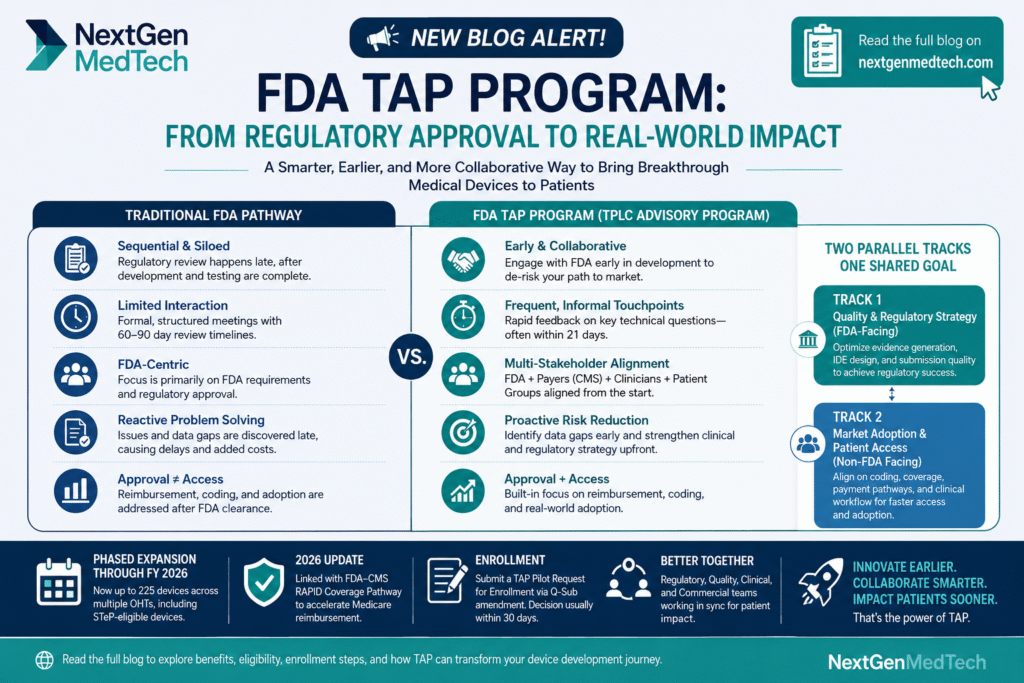
Traditional FDA Process vs TAP Program
| Traditional Process | TAP Program |
|---|---|
| FDA interaction primarily during formal submissions | Continuous FDA engagement throughout development |
| Limited communication windows | Frequent informal discussions |
| Focus only on FDA requirements | FDA + reimbursement + clinicians + patients |
| Separate commercialization planning | Integrated market access strategy |
| Reactive problem solving | Proactive risk reduction |
The TAP model shifts the regulatory function from simply obtaining approval to enabling successful product adoption.
What Makes the TAP Program Different?
1. Dedicated FDA TAP Advisors
Instead of interacting only through formal review teams, participating companies receive dedicated FDA TAP Advisors.
These advisors provide ongoing guidance throughout development.
Rather than waiting months for formal responses, sponsors can discuss:
Clinical study design
Sterility validation
Biocompatibility strategy
Human factors planning
Software validation
Manufacturing considerations
Regulatory expectations
This collaborative relationship significantly reduces uncertainty before formal submissions.
2. Faster Technical Feedback
Traditional Q-Submissions typically follow structured review timelines ranging from 60 to 90 days.
Within the TAP Program, many technical questions can receive feedback in approximately 21 days, allowing development teams to make faster design decisions.
This reduces project delays while improving submission quality.
3. Multi-Stakeholder Collaboration
Perhaps the most innovative aspect of TAP is that it extends beyond FDA interactions.
The program encourages early discussions involving:
FDA experts
CMS and reimbursement stakeholders
Healthcare providers
Clinical investigators
Patient advocacy organizations
Industry experts
Instead of designing clinical studies solely to satisfy FDA requirements, sponsors can generate evidence supporting reimbursement and clinical adoption simultaneously.
The Two-Track Strategy
Every enrolled device follows two complementary development tracks.
Track 1: Quality & Regulatory Strategy (FDA-Facing)
This track focuses on regulatory readiness.
Key activities include:
Clinical evidence planning
IDE strategy
Risk management
Submission planning
Data gap identification
Interactive review preparation
Quality documentation
Primary objective:
Prevent costly deficiencies during FDA review.
Track 2: Market Adoption & Patient Access
This second track focuses on commercialization.
Topics include:
Coding strategy
Coverage pathways
Medicare reimbursement
Payment planning
Clinical workflow integration
Physician adoption
Instead of collecting data only for FDA approval, clinical studies are designed to satisfy reimbursement requirements simultaneously.
This dramatically shortens the timeline between FDA authorization and real-world patient access.
FDA and CMS RAPID Coverage Pathway (2026 Update)
One of the most exciting developments occurred in 2026.
The FDA and CMS jointly announced the Regulatory Alignment for Predictable and Immediate Device (RAPID) Coverage Pathway.
The RAPID initiative works alongside the TAP Program.
Its objective is straightforward:
Accelerate Medicare reimbursement for breakthrough medical devices.
Under RAPID:
FDA and CMS coordination begins earlier.
Medicare evidence requirements are considered during clinical trial planning.
Clinical trials involving Medicare beneficiaries can support faster reimbursement decisions after FDA authorization.
This represents one of the strongest examples of regulatory alignment seen in recent years.
Who Can Participate?
The TAP Program is voluntary.
However, enrollment is highly selective.
Currently, devices must meet several important eligibility requirements.
Core Requirements
The device must:
Be in early development.
Not yet have initiated its pivotal clinical study.
Hold one of the following FDA designations:
Breakthrough Device Designation
Safer Technologies Program (STeP)
Only qualifying technologies are considered for enrollment.
TAP Expansion Timeline
The FDA intentionally expanded the program in phases.
FY 2023 – Pilot Launch
The program officially launched in January 2023.
15 enrolled devices
Cardiovascular Devices (OHT2)
FY 2024 – First Expansion
Beginning October 2023:
Enrollment increased to 60 devices
Added Neurological and Physical Medicine Devices (OHT5)
FY 2025 – Additional Technology Areas
Starting October 2024:
Enrollment increased to 125 devices.
Additional participating divisions included:
Ophthalmology
Orthopedics
Radiological Health
FY 2026 – Major Expansion
During mid-2026:
Enrollment increased to 225 devices.
Several new technology areas became eligible:
Surgical Devices
Infection Control
Dental Devices
ENT
Renal
Gastroenterology
Transplant Technologies
Additionally,
STeP-designated devices officially became eligible for TAP enrollment.
How to Enroll in the TAP Program
Many professionals mistakenly believe TAP requires a separate application portal.
It does not.
Enrollment occurs through the FDA’s existing Q-Submission (Pre-Submission) process.
Step 1: Confirm Eligibility
Ensure the device:
Has Breakthrough or STeP designation.
Is within an eligible clinical division.
Has not yet begun its pivotal study.
Step 2: Prepare a Q-Submission Amendment
The sponsor prepares an amendment referencing the original Q-Submission associated with the Breakthrough or STeP designation.
Step 3: Include Required Administrative Information
The amendment should clearly include:
Subject heading:
TAP Pilot Request for Enrollment
Sponsor name
Sponsor address
Original Breakthrough/STeP Q-Submission tracking number
Step 4: Submit Electronically
The amendment is submitted through the FDA’s standard electronic submission process using:
eSTAR
CDRH Customer Collaboration Portal (CCP)
The FDA generally evaluates enrollment requests on a first-come, first-served basis, with responses typically issued within 30 days.
Benefits for Regulatory Affairs Professionals
The TAP Program fundamentally changes the role of regulatory professionals.
Instead of acting only as compliance experts, regulatory teams become strategic business partners.
Major advantages include:
Earlier Regulatory Clarity
Development teams understand FDA expectations before major investments are made.
Higher Submission Quality
Potential deficiencies are identified before formal review.
Faster Development
Frequent discussions eliminate months of unnecessary waiting.
Better Clinical Studies
Clinical protocols satisfy both FDA and reimbursement evidence requirements.
Improved Commercial Success
Products are better positioned for reimbursement and physician adoption immediately after market authorization.
Benefits for Quality Management Teams
Quality professionals also benefit significantly.
Early FDA engagement supports:
Better Design Control implementation
Improved Risk Management
Stronger Design History Files (DHF)
Higher-quality verification and validation planning
More robust clinical evidence documentation
Rather than correcting deficiencies after development, quality activities become proactive.
Practical Example
Imagine a startup developing an AI-assisted cardiovascular monitoring device.
Without TAP:
Clinical studies are designed only for FDA clearance.
FDA approves the device.
CMS requests additional evidence.
Reimbursement is delayed by years.
With TAP:
FDA advisors recommend stronger clinical endpoints.
CMS reimbursement expectations are discussed early.
Physicians provide workflow feedback.
Clinical studies satisfy multiple stakeholders simultaneously.
The device reaches patients faster with fewer commercial barriers.
Common Misconceptions About TAP
Myth 1: TAP guarantees FDA approval.
Reality: TAP provides advisory support but does not guarantee clearance or approval.
Myth 2: TAP replaces Pre-Submissions.
Reality: TAP builds upon the existing Q-Submission framework rather than replacing it.
Myth 3: TAP is available for all devices.
Reality: Participation is currently limited to eligible Breakthrough and STeP devices within participating FDA divisions.
Myth 4: TAP only helps regulatory affairs.
Reality: TAP benefits clinical, reimbursement, quality, engineering, and commercialization teams simultaneously.
The Future of FDA Regulation
The TAP Program represents a significant shift in how medical device regulation is evolving.
Rather than viewing FDA review as a single approval milestone, the agency now emphasizes the entire product lifecycle—from concept and clinical development to reimbursement, adoption, and patient access.
This collaborative approach reflects a broader trend toward integrated regulatory science, where successful innovation depends not only on demonstrating safety and effectiveness but also on ensuring that patients can access the technology without unnecessary delays.
As programs like TAP continue to expand and align with initiatives such as the FDA-CMS RAPID Coverage Pathway, early regulatory engagement will become an increasingly important competitive advantage for medical device manufacturers.
Conclusion
The FDA’s Total Product Life Cycle Advisory Program is more than an enhancement to the Q-Submission process—it represents a strategic transformation in medical device development. By fostering early collaboration between the FDA, manufacturers, clinicians, payers, and patient groups, TAP helps reduce regulatory uncertainty, improve submission quality, and accelerate the journey from innovation to patient care.
For organizations developing Breakthrough or STeP-designated devices, participating in TAP can mean fewer surprises during review, stronger clinical evidence, earlier reimbursement planning, and a smoother path to market adoption. In an increasingly complex regulatory environment, integrating regulatory strategy with commercial planning from the outset is no longer optional—it is a key driver of long-term success.
Whether you are a regulatory affairs specialist, quality engineer, clinical professional, or MedTech entrepreneur, understanding and leveraging the TAP Program can position your organization to bring transformative medical technologies to patients more efficiently and with greater confidence.
Official Links & Resources
The official hub for all program updates, detailed guidance, and contact channels can be accessed directly through the FDA’s web portal:
· Main Program Portal: For the complete program scope and structural guidelines, visit the FDA Total Product Life Cycle Advisory Program (TAP) Official Home.
· Enrollment & Criteria Guidelines: To review specific administrative text requirements and active clinical tracks, check the FDA TAP Pilot Enrollment & Expansion Page.